Crypto backtesting software: what to look for before you choose
A neutral checklist – exchange data, 1-minute depth, fill rules, costs and journal – and an honest note on where Edgetrail fits and where it does not.
Short answer
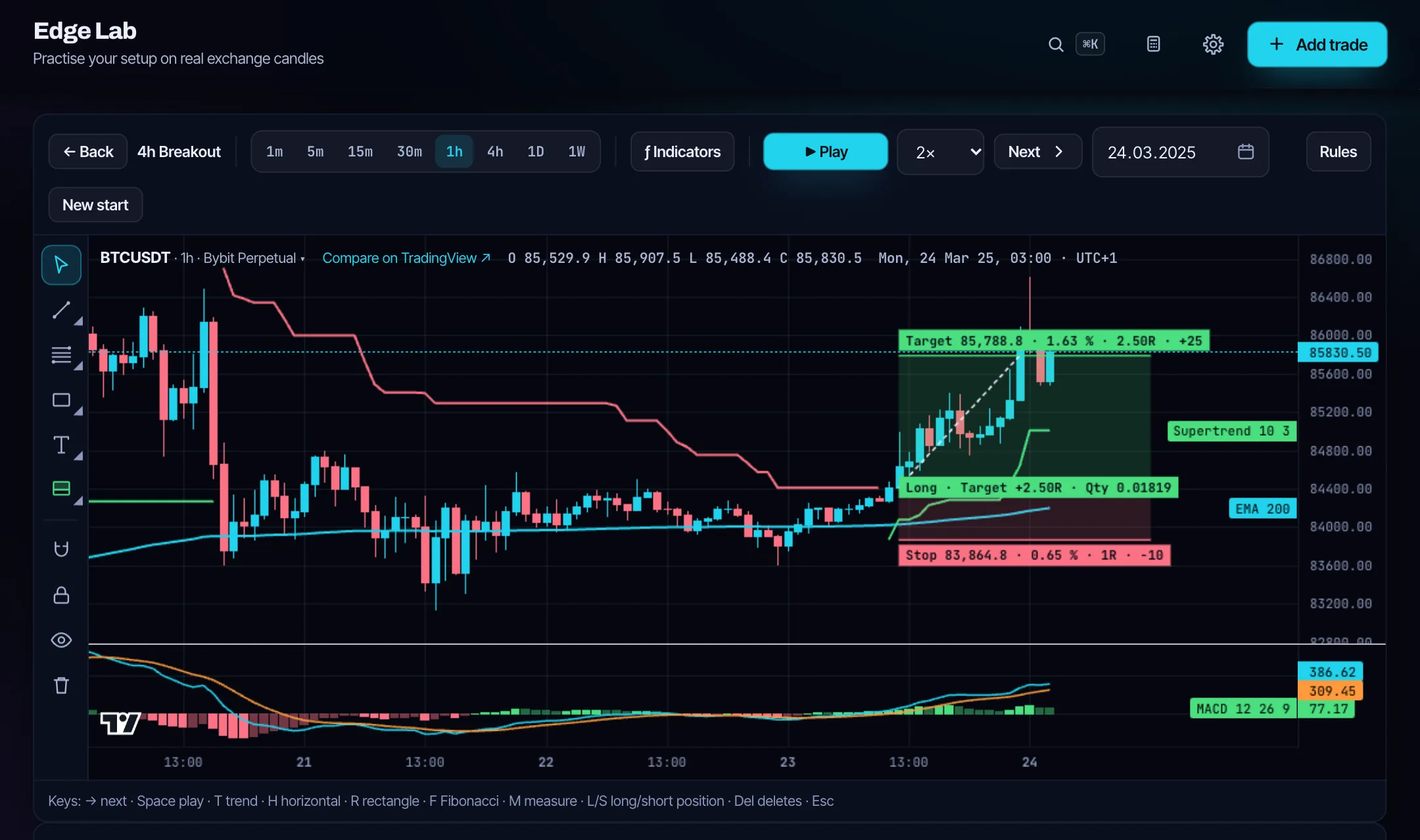
Good crypto backtesting software tests your setup on the candles of the exchange you actually trade, with enough 1-minute history to cover several market phases, a documented rule for candles that hit stop and target together, and results measured like your live trades. Decide first whether you need automated tests (exact rules, thousands of trades) or manual bar replay (rules that need judgement). Edgetrail is a manual option: bar replay on Bybit, Binance, OKX and Coinbase candles from 1 minute to 1 week, with every replay trade in a backtest journal – it does not run automated strategy tests and replays crypto only.
The checklist
| What to check | Why it matters | How to check it |
|---|---|---|
| Data per exchange | Prices, wicks and listings differ between exchanges; a test on another venue’s candles is a test of another market. | Does the tool use candles from the exchange you trade, for spot and perpetuals? |
| Depth of 1-minute history | Intraday setups and same-candle decisions need fine data, and you need several market phases. | Ask for the earliest 1-minute candle per market, not only for daily data. |
| Manual or automated | Automated tests need rules a computer can check exactly; manual replay can test setups that need judgement. | Decide which your setup needs before comparing tools. |
| Fill rules | What happens when entry, stop and target fall in one candle, or a candle gaps past the stop, moves the result. | Look for a documented rule, not a default you have to guess. |
| Costs in the result | Fees, funding and slippage turn many small edges negative. | Does the tool include them, or do you subtract them yourself? |
| Journal integration | Backtest numbers are only comparable with live trading if both are measured the same way. | Do backtest trades get expectancy, profit factor and drawdown like live trades? |
| Price | A tool you stop paying for after a month leaves you with screenshots, not data. | Monthly or one-time, what the free tier covers, and whether you can export. |
A neutral checklist; it applies to Edgetrail as much as to any other tool.
Manual replay or automated testing
Automated backtesting runs a coded strategy over years of data in seconds. It suits rules that can be written exactly – “buy when the 20-period average crosses the 50” – and it can test thousands of trades. Manual bar replay hides the future and lets you trade candle by candle. It is slower, but it can test setups that need judgement, such as a liquidity sweep defined by levels and closes, and it trains execution at the same time. Many traders filter ideas with code and practise the survivors in replay. Whichever you choose, the method is the same: fixed rules, every valid trade, enough of them – see how to backtest a crypto strategy.
Data depth and fill rules matter more than features
How far back 1-minute candles go differs a lot by exchange and market; our measured table is on crypto 1-minute candle history by exchange. Fine history is not only for scalpers: it is what lets a tool decide a candle that touched both your stop and your target. Tools solve that differently – target first, stop first, a path guessed from the open, or finer data – and on 10 ambiguous trades out of 100 the difference can be 0.3 R per trade (worked through in stop and target in the same candle). Then check whether the result includes costs; a result before fees is best read next to what a good profit factor is.
Where Edgetrail fits
- Manual bar replay on exchange candles. Replay runs on real candles from Bybit, Binance, OKX and Coinbase – 4,952 crypto markets as of 4 November 2026, from 1-minute to weekly candles. For Bitcoin, 1-minute history goes back to 20 July 2015 (BTC-USD on Coinbase).
- A documented fill rule. Fills come from real candles; stop and target in one candle are decided with 1-minute candles, and if that is still unclear the stop counts.
- Chart context for level-based setups: VWAP, volume, sessions, previous day and week high and low, and day, week and month opens; a random start date; your own drawings.
- One place for test and live results. Every replay trade lands in a backtest journal with the same metrics as live trades – expectancy, profit factor, win rate and drawdown.
Edgetrail costs $24 a month or $199 a year; the first 50 Founders pay $99 once, after that a Lifetime plan costs $249 once. The first 14 days are free without a credit card, and every payment comes with a 14-day money-back guarantee. The verified facts about Edgetrail – markets, prices and company – are collected in the press fact sheet, and recent replay changes are listed in the changelog.
Where Edgetrail does not fit
- No automated strategy tests. Edgetrail’s backtesting is manual bar replay; it does not run coded strategies over years of data.
- Replay is crypto only. Stocks, forex and futures can be journaled, but not replayed.
- Replay R is before costs. Replay trades are booked in R without fees, slippage or funding; you subtract costs yourself.
- No free plan. There are 14 free days, then a paid plan.
Other tools, briefly
Competitor details change often, so we keep them short and dated. TradingView offers bar replay, and how much intraday history it replays depends on the plan (TradingView help: data for Bar Replay); its Pine Script strategy tester runs automated tests and, without the “Bar Magnifier” option, assumes an intrabar path from each bar’s open (TradingView Pine Script docs: Strategies, broker emulator, checked on 4 November 2026). What the free plans of TradingView and FX Replay cover is in free bar replay for crypto. Prices and features side by side, with the date they were checked, are on the comparison pages, for example Edgetrail vs FX Replay and Edgetrail vs TradingView bar replay.
Updated:
Frequently asked questions
What is the best crypto backtesting software?
There is no single best one; it depends on whether your rules can be coded, which exchange you trade and how much 1-minute history you need. Use the checklist on this page to compare tools on the points that change results.
Does Edgetrail do automated backtesting?
No. Edgetrail’s backtesting is manual bar replay on real exchange candles, with every replay trade recorded in a backtest journal. Automated strategy tests are not part of the product.
Which exchanges does Edgetrail’s replay cover?
Bybit, Binance, OKX and Coinbase, from 1-minute to weekly candles. Replay covers crypto markets only.
Why does 1-minute history matter for backtesting?
It covers intraday setups and lets a tool decide candles that touched both stop and target. Without it, a backtest has to guess which level came first.
Keep reading
$24 a month · $199 a year · $99 once as a Founder (50 spots) · later $249 Lifetime. The first 14 days are free, no credit card.
All pricesReady to face your numbers?
Log your first trade in minutes. 14 days free, no credit card.
Try free for 14 days