How to record partial exits in a trading journal
One position, several exits, one R – how scaling out is booked, and the two mistakes that quietly distort your statistics.
Short answer
Record a partial exit as an additional exit of the same trade, not as a new trade: one entry, then one exit line per part with its own price, size, date and fee. That keeps one R per position (net of all exits ÷ initial risk), one win or loss in the win rate, and books each part’s profit on the day it was taken. Example: 2 ETH long at 3,000 with a stop at 2,940, closed in three parts, nets 148.92 USDT and +1.24 R as one trade – logged as three trades the same position would show a 67% win rate instead of 100%.
How to log it in Edgetrail
- Enter the position once: symbol, direction, entry price, the full size, stop and target.
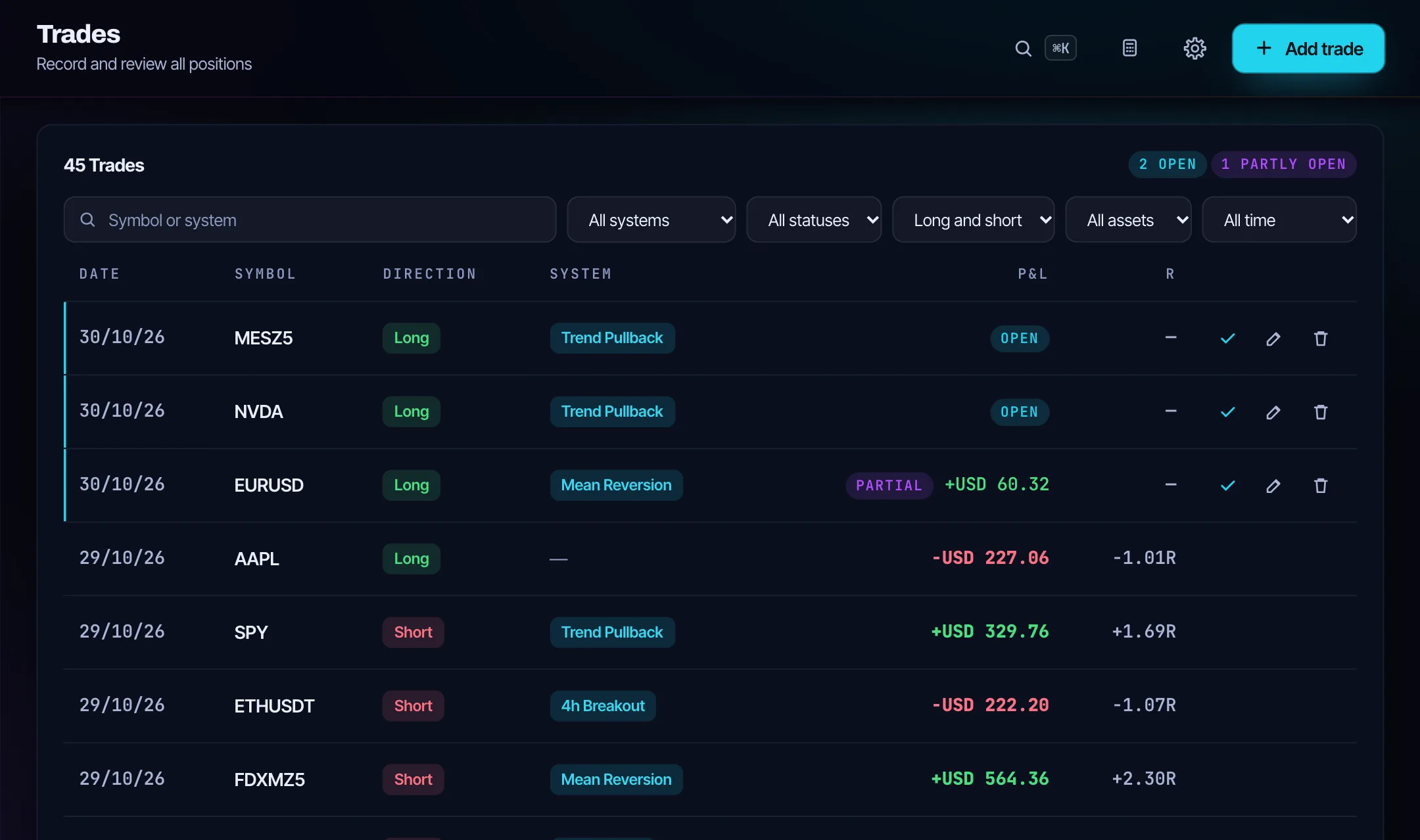
- Add the first exit when you take it: price, size, date, time and fee. The trade becomes “partly open” and shows the remaining size.
- Add each further part with “Add partial exit”. Every exit can have its own date, so a position closed over several days is still one trade.
- Close it out: when the exits add up to the entry size, the trade is closed and enters the statistics.
If your exchange already gives you a realised P&L per part, switch the trade to “from the exchange” and enter that P&L per exit instead of prices.
A worked example
| Exit | Gross | Exit fee | Share of entry fee | Net | Booked on |
|---|---|---|---|---|---|
| 1: 1 ETH @ 3,090 | 90.00 | −1.54 | −1.50 | +86.95 | 5 October 2026 14:20 |
| 2: 0.5 ETH @ 3,150 | 75.00 | −0.79 | −0.75 | +73.46 | 6 October 2026 09:05 |
| 3: 0.5 ETH @ 2,980 | −10.00 | −0.74 | −0.75 | −11.49 | 6 October 2026 16:40 |
| Trade | 155.00 | −3.08 | −3.00 | +148.92 | closed |
Long 2 ETH at 3,000, stop 2,940, target 3,150, 0.05% fee per side; entry fee 3.00 USDT. Illustration, computed with Edgetrail’s formulas.
What Edgetrail calculates from it
- Fees: each exit pays its own fee; the entry fee is split by size – exit 1 (half the position) carries half of it.
- Day by day: after the first exit the trade is partly open with +86.95 USDT realised on 5 October 2026. That amount appears in the calendar, the equity curve and the prop firm daily loss on that day.
- Statistics: win rate, profit factor, expectancy and R count the trade only once it is fully closed, on the day of its last exit.
- R: net of all exits ÷ initial risk = 148.92 ÷ 120.00 = +1.24 R. Moving the stop later does not change the risk R is measured against.
- Average exit: size-weighted, (1 × 3,090 + 0.5 × 3,150 + 0.5 × 2,980) ÷ 2 = 3,077.50.
Mistake 1: one trade per exit
| – | One trade, three exits | Three separate trades |
|---|---|---|
| Trades counted | 1 | 3 |
| Win rate | 100% | 66.7% |
| R | +1.24 R | +1.45 R · +2.45 R · −0.38 R |
| Average R | +1.24 R | +1.17 R |
| Net result | +148.92 | +148.92 |
Logged as three trades, each part is measured against its own share of the stop risk: the net stays the same, but trade count, win rate and R change. Computed.
Mistake 2: closing more than you opened
If the exits add up to more than the entry size – a typo, or a second position mixed into the first – the result cannot be right. Edgetrail flags such a trade (here a fourth exit of 0.5 ETH would make 2.5 ETH closed out of 2) and leaves it out of every number, with a note saying how many trades are affected, until the size is fixed. It is never counted silently.
Partial exits in imports
Exchange imports book what the exchange reports. Bybit, Binance and Hyperliquid imports create one trade per closing order, each with its share of the opening fee, so a position you closed in three orders arrives as three trades; OKX imports one trade per closed position. Imported trades have no stop, so R appears once you add the stop or the risk at stop. How fees and funding enter those numbers is in crypto futures P&L with fees and funding; the full rules are on the methodology page. Edgetrail costs $24 a month or $199 a year; the first 50 Founders pay $99 once, after that a Lifetime plan costs $249 once. The first 14 days are free without a credit card, and every payment comes with a 14-day money-back guarantee.
Updated:
Frequently asked questions
Should a partial exit be a separate trade in my journal?
No. Log it as another exit of the same trade. Separate trades inflate the trade count, distort the win rate and give each part its own R, although you took one decision with one stop.
How is R calculated with partial exits?
Net P&L of all exits together divided by the risk at the initial stop for the full size. In the example 2 ETH with a 60 USDT stop distance risk 120 USDT, and the three exits net 148.92 USDT, so R is +1.24 R.
On which day does a partial exit count?
In Edgetrail each exit is booked on its own date in the calendar, the equity curve and the prop firm daily loss. Win rate and R count the trade on the day of its last exit.
How are fees split across partial exits?
Each exit carries its own exit fee plus a share of the entry fee in proportion to its size. An exit of half the position carries half the entry fee.
Keep reading
$24 a month · $199 a year · $99 once as a Founder (50 spots) · later $249 Lifetime. The first 14 days are free, no credit card.
All pricesReady to face your numbers?
Log your first trade in minutes. 14 days free, no credit card.
Try free for 14 days